
Sharpsburg Collage


Sharpsburg Entrenched in History
Population 670
As you travel through soft, curving hills, past grazing animals and rich fields into the small, quiet town of Sharpsburg, it is hard to imagine the stream of activities and events which occurred here. Before the famous battle, before the thriving town, and before the statesman's country manor, there was the Great Spring surrounded by deep, green forest and the trails of the Delaware and Catawba Tribes. This spring, which nourished Native American families for thousands of years before the Europeans came, is perhaps the only thing that hasn't changed.

By 1740, Joseph Chapline established a manor called Mount Pleasant on several thousand acres deeded to him by the colonial governor of Maryland in exchange for extending civilization into the area and protecting it from the natives. His estate included a fine mansion, a chapel, a gristmill, a racetrack and near the Great Spring he established a trading post.  In 1763 with the French Indian Wars finally over, Chapline established a town, naming it after his friend, Governor Horatio Sharpe. Thus families began to arrive in Sharpes Burgh, building their homes around the Great Spring.

By 1820 the population was at 650. Over the next forty years, with people moving west from the cities and the advent of the C&O Canal, the town grew.  By the time of the Civil War, the population doubled to 1300 inhabitants who supported many churches, stores and businesses.  Families were large and connected with each other by marriage.  Although wells were dug, the Great Spring was still a major source of water and a gathering place for the people.

There are many historic places in the United States, but few hold the sad peace of a place where thousands died.  Sharpsburg, and the Antietam Battlefield around it, is such a place. This peaceful family town was the place where the slow moving giant armies exploded, leaving 23,000 dead and wounded. To the armies it was just land, with a large creek on the border between the North and the South. For the citizens it was a cold, rolling tide from which they could not escape. The thundering devastation of 500 cannons must have been terrifying, and the aftermath a disaster we can only imagine. Not only were homes and farms damaged or destroyed and pantries emptied, but the people listened to the screams of the injured and smelled the stench of death and suffering for months.  There were no empty floors, no elegant parlors, no peaceful churches that fall. The little town was marked forever.  The only thing that didn't change was the Great Spring which, while watering soldiers and their horses, kept flowing through it all.

The families in Sharpsburg did survive.  They tore down badly damaged buildings like the old Lutheran church on Cemetery Hill, and used what materials they could to repair others.  The nation was properly horrified.  President Lincoln came to visit the troops. When the war was finally over, Sharpsburg began a new struggle, having been redefined as a battle town and a pilgrimage site for veterans and widows of the battle.  The townspeople welcomed them, planting Norway maples to shade them along the road from the train station to the National Cemetery.  Many would stop at the Great Spring to reminisce and drink from the old dipper that always hung there.

After the war, Sharpsburg's population declined until today, as in 1820, it is about 650 people, many of whom are direct descendants of the families who survived the battle in 1862.  While visitors can still feel the profound stillness of the battlefield, the people of Sharpsburg are proudest of the fact that their town remains a rural village of real families gathered around the ever flowing Great Spring.

Memorial Day Parade One of the Nation's Oldest
Sharpsburg claims one of the original Memorial Day parades in the United States. Begun soon after the war as Decoration Day, the celebration was to honor the soldiers of the Civil War. The veterans of the Battle of Antietam would march from the West end of town to the National Cemetery to honor their fallen comrades, renew friendships and view the battlefield once more. Later, as Memorial Day, to honor all our nation's veterans, the parade drew thousands of people to Sharpsburg to see the many marching bands, dignitaries and costumed school children.

Today the tradition continues. Townspeople can be seen painting, sweeping the streets and decorating for the event which is held Saturday afternoon of Memorial Day weekend. Carloads of families pour into town  and the Rohrersville Band (est. 1837) plays patriotic music on the town square at noon.  Great cheers erupt as the parade begins and the school bands come marching through followed by baton twirlers, beauty queens and Little League teams.  Join us for this great family event where patriotism carries the day.

Sharpsburg Heritage Festival Draws Large Crowds
``Did you know Southerners call the Battle of Antietam the Battle of Sharpsburg?' asks eighty-seven year old Charlotte Davis. Every September during the Sharpsburg Heritage Festival, Mrs. Davis and other costumed guides tell the story of a day when the town captured the attention of the nation. . . the bloodiest single day of battle in American history.

Consider this your invitation to attend the Sharpsburg Heritage Festival. Rated one of the best fall events in Maryland, the annual Festival coincides with special battle anniversary tours and exhibits offered at the Antietam National Battlefield.

As you stroll through town, speak with the many Rebels and Yankees who are camped in the yards of the Colonial and Civil War homes. Listen to the continuous concerts of Civil War music, attend one of the many free historical lectures or workshops.  Wander through our arts area featuring folk art, Appalachian crafts and demonstrations of the lost arts of the 18th and 19th centuries. Enjoy the homemade food produced by our churches and service clubs.  There is something for every one at this great family event.

Call 1-800-228-STAY for a free trip planning guide about the Festival and related activities at the Antietam Battlefield.

Illumination of Antietam Honors Battle's Dead
The Memorial Illumination of Antietam National Battlefield in Sharpsburg, Maryland, serves as a visual remembrance of those brave soldiers who gave the ultimate sacrifice so that Americans could possess the freedoms that they enjoy today.

Candles are lit to honor 23,110 Union and Confederate soldiers, who were casualties of the Battle of Antietam on September 17, 1862.

Each year hundreds of volunteers place luminaries on the Battlefield for this commemoration.

This illumination takes place the first Saturday in December. 

Relive the Bloodiest Day of the Civil War at Antietam National Battlefield:
The Battle of Antietam (or Sharpsburg) on September 17, 1862, climaxed the first of General Robert E. Lee's two attempts to extend the Confederate effort into the North. Some 41,000 Southerners were pitted against the 87,000-man Federal Army of the Potomac under General George B. McClellan. When the fighting ended on that fateful day, the course of the American Civil War had been greatly altered.

More men were killed or wounded at Antietam than on any other single day of the Civil War. Federal losses numbered 12,410 with Confederate losses reaching 10,700. Although neither side gained a decisive victory, Lee's failure to carry the effort effectively into the North produced two important results for the Federalists:  Great Britain postponed the recognition of the Confederate government, and President Abraham Lincoln issued the Emancipation Proclamation on January 1, 1863, freeing all slaves in the rebellious states. Hence, the Civil War embraced the dual purpose of  preserving the Union and ending slavery.

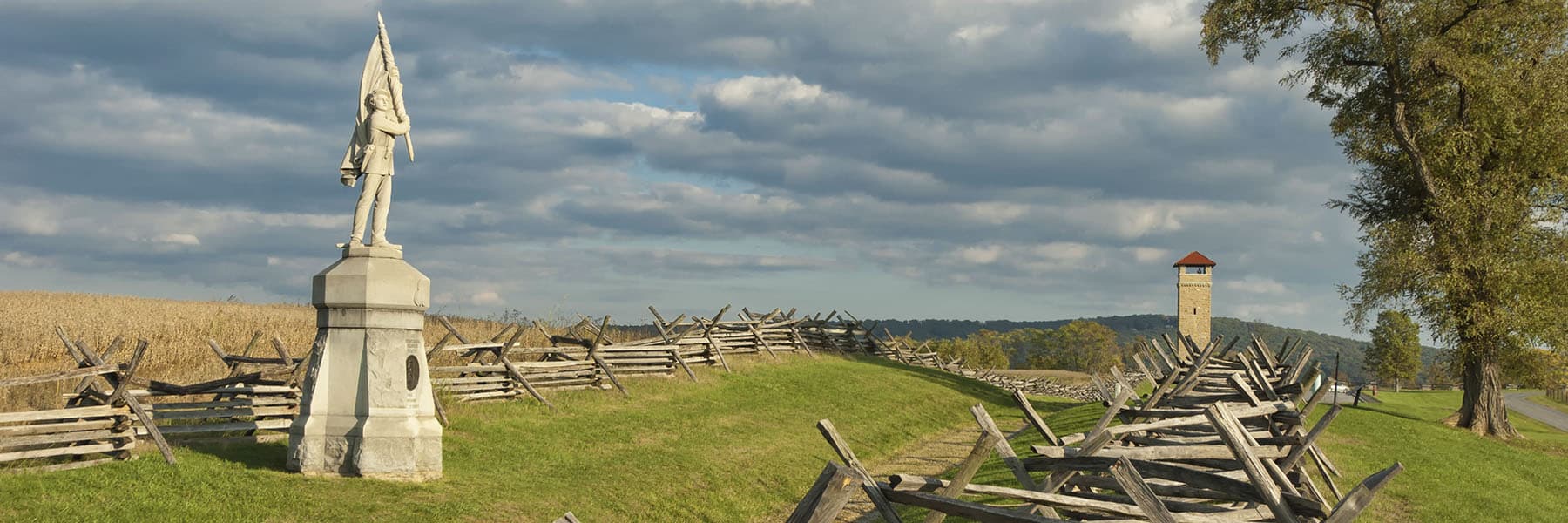
Open year round, this national treasure encompasses an 8 ˝ mile driving tour which includes such highlights as Dunker Church, Cornfield, Bloody Lane and Burnside Bridge. The battlefield is dignified with more than 350 monuments, tablets, and markers and 41 authentic cannons.

Back